Obsidian Entertainment’sThe Outer Worldsis a game from a bygone era. It’s a modernized RPG where NPCs turn to face the player character and a number of choices appear just to make a greeting. Where the character sheet is filled with stats and numbers that represent the type of hero/anti-hero the player wants to control. To put it simply,The Outer Worldsis a staggering combination of moving parts tailor-made for the hardcore RPG fan.
The foundation ofThe Outer Worldsis a far-reaching space adventure that has the player character exploring a number of planets, completing a diverse array of tasks, and ultimately working towards a central goal. But there are so many diversions away from the main goal that players will be engrossed just moving from one objective to the next. Every new NPC typically has some task they would like to see completed, and the player can oblige if they choose.

Each of the quests is built in such a way that there is no point A to point B solution. Sometimes thedialogue choices can solve the problemright out of the gate, while other times a little prodding will uncover optional solutions and objectives. In most cases, the goal of each quest is not as cut and dry as helping the good guys topple the bad guys, and usually, there is no “right” answer.
RPGs often use the illusion of choice to give players the feeling that there are many different outcomes in front of them.The Outer Worldsactually presents those choices in a way that makes it feel like every response selected is evolving the relationship between the player character and the world around them. Obsidian has put a ton of detail into every NPC, giving them backstories, motivations, and even developing personalities. They are so much more than quest givers.

Add to that a companion system that lets players take up to two characters along for their journey (at a time), and the options expand from there. Every companion has their own opinions about quests and will often time comment on the choices that the player has made. Usually, companion characters are relegated to their role in combat or who seems the “coolest,” butThe Outer Worlds’ companions legitimately impact the story and it was difficult choosing who to take along.
Alongside the amount of agency that players have in the interactions with the world, the customization available to “building” their character is just as involved. The look of the character is arguably the least impressive element of the customization, but the layers underneath can support a variety of approaches. Players can put points (earned through XP) into a number of categories like Defense, Ranged Attacks, or Stealth, which have three sub categories within those larger groups.

At first, the goal is to give the character a general platform to work from. Are they a character that likes ranged attacks and strong defense? Or do they prefer using the companion characters to do all of the heavy lifting? Then, as they level up even further, players can go into the smaller categories (like hacking or medical) to put points into those. Each of the smaller categories has bonuses associated with hitting certain point thresholds. For example, at 40 points into long range weapons, players will unlock extra damage to critical hits.
Every other level up also unlocks a perk point, which is a type of free-for-all upgrade like extra base health or more damage for companions. The game is very generous in its leveling system and so players can trulycustomize their characteras they see fit. They can also make choices that might seem enticing at first and not feel as though their time has been wasted. Eventually, though, their experience withThe Outer Worldswill make clear how they prefer to play and the options to suit those playstyles are very diverse.
It may seem odd thatThe Outer Worldshas so much going for it without discussing the combat, but that feels by design. The combat in the game suits the customization and there is a fun selection of weapons to play around with (melee weapons, laser weapons, etc.), but this is not a fast-paced first person shooter. Just like choices must be made when interacting with NPCs, the gunplay has a strategic element to it. Players can rush in if they choose, but through theuse of Time Dilation(basically a slow down mechanic), they can target specific parts of an enemy’s body and tilt the odds in their favor. For example, you can target one enemy’s hand to maim them and take their weapon out of the equation (for a time) and then snipe another in the head to blind and confuse them.
Treating the game like a straightforward first-person shooter is a disservice to the RPG experience. That being said, the gunplay is going to feel clunky to those who attempt to run and gun. Because this is an RPG there are dice rolls and stats working behind the scenes and oftentimes that won’t support the idea that a strong weapon and precise aim can solve any problem. In fact, those who choose to run right into a group of enemies hoping to blast them away with a shotgun will find themselves quickly restarting at a checkpoint.

Mods for weapons and armor will further refine how players tailor their character, and there is a full upgrade path for almost everything in the game. What may seem like basic running and gunning can evolve in very clever ways, to the point that players are either a one-man wrecking machine or a stealthy overlord that sticks to the shadows.
The companion characters also add a new dynamic to the combat by drawing attention or helping whittle down tougher enemies. The player has total control over the companions, both in terms of what weapons they use and how they approach each encounter. Each companion even has a special attack that can be used at opportune times.

Pulling both customization, player choice, and combat together,The Outer Worldsfeels like the massive RPG that it sets out to deliver. But where some of its contemporaries deliver scope through the size of their worlds,The Outer Worldsimpresses with the amount of choices available. It’s a game that encourages multiple playthroughs and can show players completely different experiences from start to finish.
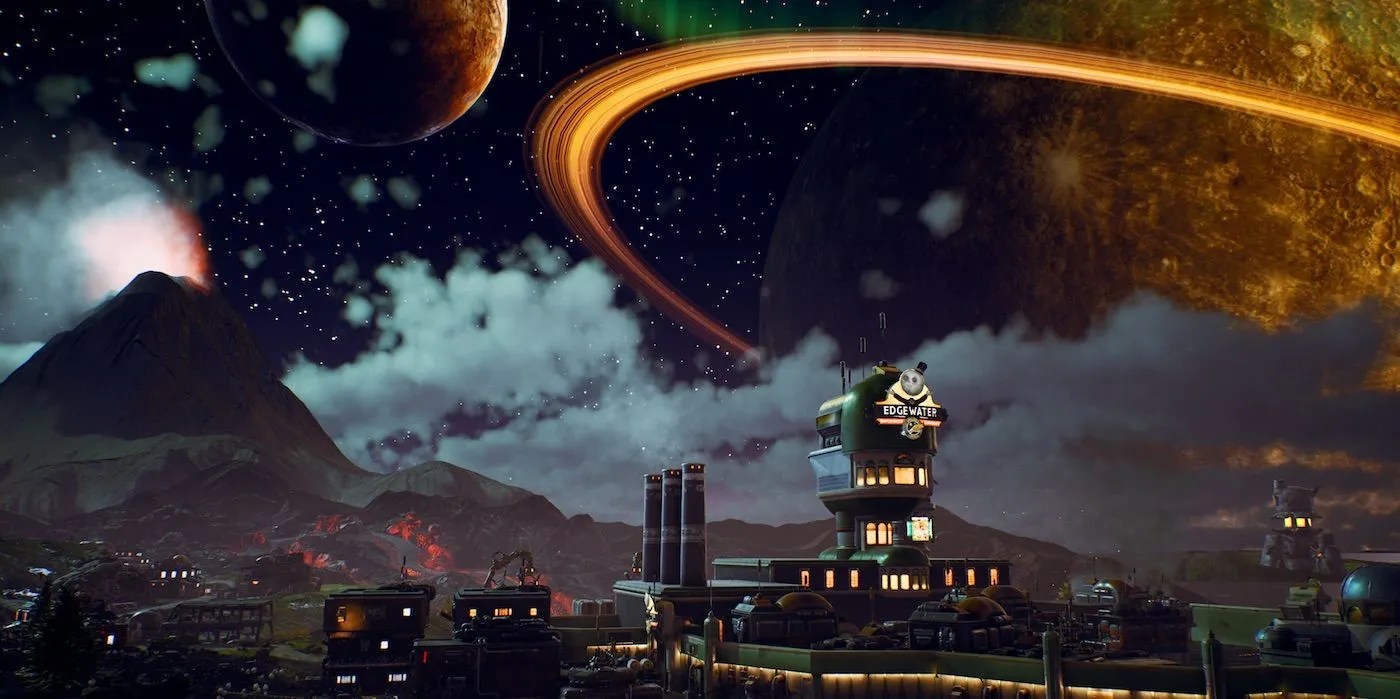
But while it may not be an open world on the level ofSkyrimorFallout 76,The Outer Worldsstill has beautiful landscapes, a unique color palette, and intriguing design elements. Like a mixture between straight sci-fi and steampunk, there is a level of creativity at work inThe Outer Worldsthat keeps it feeling familiar but still new. Exploring each new planet, world, or space installation unveiled nooks and crannies that were calling out to be explored and usually that poking and prodding carried worthwhile rewards.

So much aboutThe Outer Worldshas been cared for and cultivated to deliver an experience for a very specific brand of gamer. Not everyone is going to enjoy sitting back and having conversations with NPCs and trying to truly analyze the motivations behind the quest, but those who felt that modern RPGs are lacking will love every second ofThe Outer Worlds. It truly is incredible how much detail Obsidian has put into making sure that every element feels thoughtful and deliberate. Nothing is cut and dry and everything has a second, third, or even fourth option.
Gunplay is arguably the weakest element of the game but it’s by no means disappointing. Rather, it’s the expectations of the player that will determine if the combat is satisfying or lackluster. Personally, the combat had enough tools to play around with that it kept evolving as the story went on.

The Outer Worldsis a lot, in the best way possible. It packs so much RPG goodness into a tight package that fans are going to be engrossed from beginning to end. More importantly, the choices presented to them are so inviting and diverse that it will be easy to start up a second playthrough and feel like new experiences are on the horizon. Put simply,The Outer Worldsis thedeep sci-fi RPG that gamers have been promisedfrom so many franchises, and only now has been delivered.
The Outer Worldsreleases July 01, 2025 for PC, PS4, and Xbox One. Game Rant was provided PS4 code for this review.

The Outer Worlds
WHERE TO PLAY
Created by Obsidian Entertainment, the same company responsible for the beloved Fallout: New Vegas, The Outer Worlds is a Sci-Fi FPS adventure with RPG elements. Players will embark on an epic quest across multiple planets and areas, taking on quests from NPCs, gaining companions, and unraveling an interstellar mystery.In the game, players can create their own character and unlock a ship, which will be the central hub and fast travel access point for the game.

